
Applying in 2027? Qualifying hours on 2022 forms need to be transferred to 2027 forms
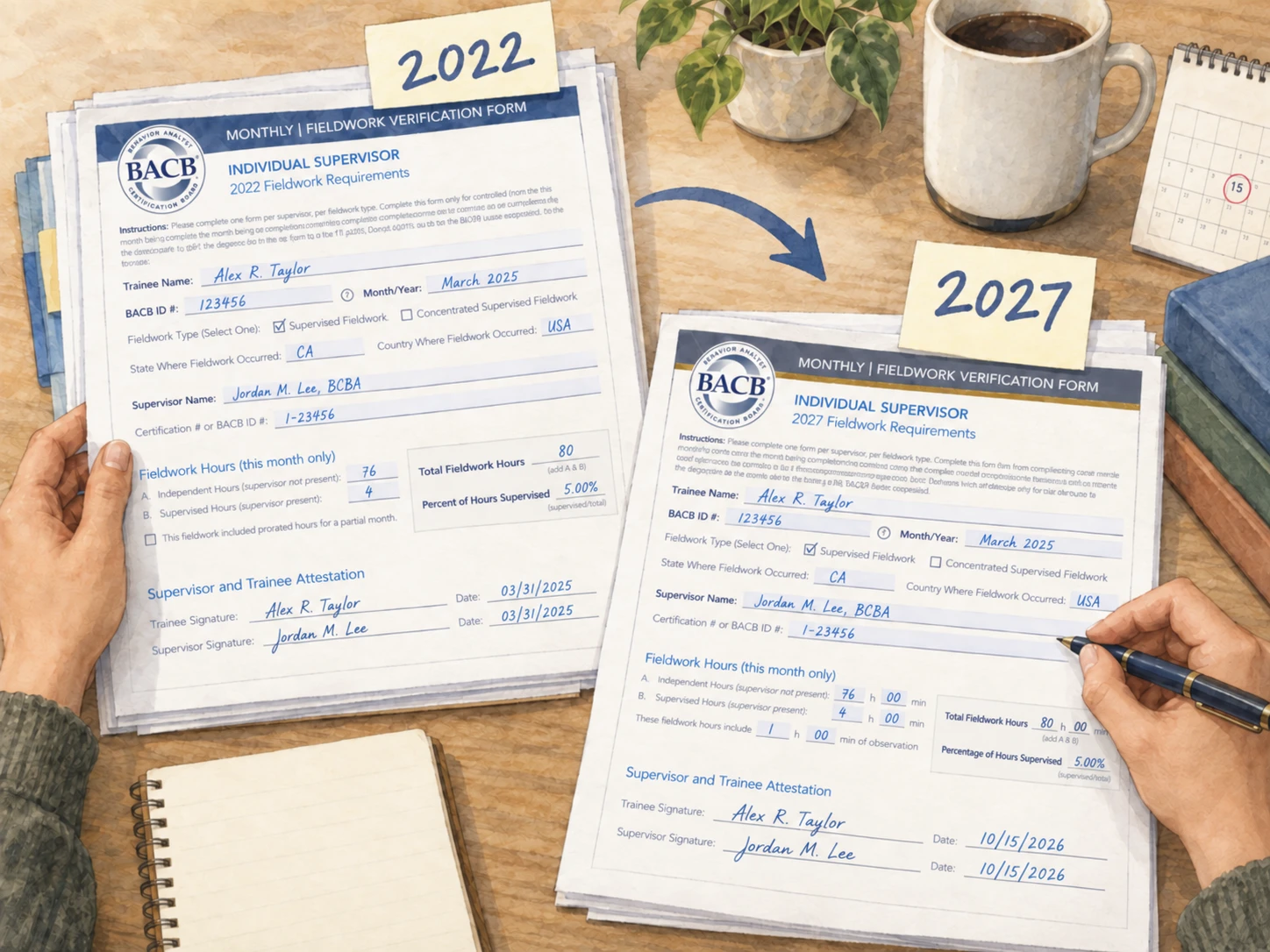
If you are accruing BCBA fieldwork now and expect to apply for certification on or after January 1, 2027, there is a paperwork issue worth addressing before application time.
Fieldwork completed under the 2022 requirements does not automatically become unusable in 2027. But if you apply under the 2027 requirements, the fieldwork you want to count must meet the 2027 standards and be documented on the corresponding 2027 fieldwork forms.
That means months you already documented on 2022 Monthly Fieldwork Verification Forms may need to be transferred to 2027 forms — provided those months actually meet the 2027 requirements. The BACB’s published transition guidance confirms that fieldwork must meet the requirements in effect when you apply and that M-FVFs must correspond to those requirements.
We wrote to the BACB to ask specifically how older months should be handled. Their response was clear, and it included an important instruction about the date your supervisor should use when signing the new form.
What the BACB said
The first part establishes the rule that governs everything else:
“Fieldwork must meet the 2027 BCBA Requirements in any application submitted on or after January 1, 2027.”
BACB, in reply to our inquiryThe BACB then explained why simply having completed the hours under the 2022 requirements is not enough:
“Due to the upcoming changes (e.g., supervision hours per supervisory period, fieldwork hours per supervisory period, observations of trainees with clients per supervisory period), fieldwork hours accrued before this date may not satisfy these requirements.”
BACB, in reply to our inquiryThat distinction matters. This is not simply a matter of copying numbers from one form to another. The underlying month itself has to satisfy the 2027 requirements.
For Supervised Fieldwork, the 2027 requirements allow 20 to 160 fieldwork hours per supervisory period, require 5% supervision, and require at least 60 cumulative minutes of observation with a client. Under the 2022 requirements, the maximum was 130 hours and there had to be one observation with a client, but there was no minimum duration for that observation.
So, for example, a brief client observation could satisfy the 2022 observation requirement but still fail the 2027 requirement if the month’s observations did not total at least 60 minutes.
For Concentrated Supervised Fieldwork, the changes run in a different direction: the 2022 requirements called for 10% supervision and one client observation, while the 2027 requirements call for 7.5% supervision and 90 cumulative minutes of observation with a client.
The important point is simple: transferring a month onto a 2027 form does not make that month compliant. The month must already meet the 2027 requirements.
The instruction about dates
Here is one detail the BACB’s published transition guide does not spell out: what date should be used when qualifying fieldwork that was documented on a 2022 form is transferred to a 2027 form.
The BACB told us:
“If your accrued hours meet the 2027 fieldwork requirements but are reflected on a 2022 Monthly or Final Fieldwork Verification form, you will need to transfer this information to the 2027 forms. Please be advised that your supervisor should be signing the new corrected form with the date the corrections were made. Please do not back date documents.”
BACB, in reply to our inquiryThat means the supervisory period stays the same, but the signature date changes.
Suppose you completed qualifying fieldwork in March 2025 and your supervisor originally documented that month using a 2022 M-FVF. If you transfer that information to a 2027 M-FVF in October 2026, the Month/Year field still says March 2025.
But if your supervisor signs the new 2027 form in October 2026, the signature should carry the actual October 2026 signing date. It should not be dated as though the new form had been signed back in March 2025.
The supervisory period tells the BACB when the fieldwork occurred. The signature date records when your supervisor signed that particular document. They are not supposed to be the same date simply because the form covers an earlier month.
What the official transition guidance adds
The BACB’s published transition guidance provides additional direction for trainees who are still accruing hours during the changeover.
All supervised fieldwork must meet the requirements in effect when the certification application is submitted. The BACB’s latest transition notice further clarifies that a complete application, including payment and all required documents, must be received by December 31, 2026 to be reviewed under the 2022 requirements. Otherwise, the 2027 requirements apply.
If you are not certain whether you will apply before or after the transition, the BACB recommends planning to satisfy both sets of requirements. That includes meeting both sets of fieldwork requirements, keeping documentation capable of demonstrating compliance with each, and ensuring all qualifying hours fall within the applicable five year period.
For the monthly forms specifically, the BACB recommends completing both the 2022 and 2027 M-FVFs each month when your eventual application date is uncertain. If you ultimately apply under the 2022 requirements, you retain the 2022 forms. If you apply under the 2027 requirements, you use the 2027 forms.
That is much easier than reaching application time and discovering that several years of older forms need to be reconstructed.
One detail that surprises people
Monthly Fieldwork Verification Forms are not submitted with the certification application. You and your supervisor retain them as supporting documentation. The BACB requires fieldwork documentation, including M-FVFs, to be retained for at least seven years and provided if requested.
That is why a problem with an older monthly form can remain unnoticed for a long time and then become important during an audit or documentation review.
It is also why the records behind the form matter. If your 2022 form establishes that an observation occurred but your 2027 form needs the actual number of observation minutes, you need documentation capable of supporting that duration. The BACB specifically recommends tracking both the number of client observations and the duration of those observations during the transition.
The BACB will not pre-approve your hours
One more part of the BACB’s response is worth knowing. You cannot send your accumulated fieldwork to the BACB now and receive an advance determination that every month will be accepted when you eventually apply.
As the BACB told us:
“If further clarification is needed, we recommend reaching out to your supervisor. They will be the individuals attesting that all requirements were met and are the ones that oversee your hours and sign off on them.”
BACB, in reply to our inquiryYour supervisor’s attestation is therefore critical. Before transferring older months, you and your supervisor need to determine whether the underlying records actually establish that the 2027 requirements were met.
What to do now
- Determine when you expect to apply. If your complete application will not be received by December 31, 2026, prepare for the 2027 requirements.
- Review your older months against the 2027 requirements. Do this month by month rather than looking only at your total accumulated hours. Pay particular attention to documented observation duration.
- Transfer qualifying months onto the appropriate 2027 forms. The hours and supervisory period remain the historical information from that month.
- Have your supervisor sign the new form using the actual date it is signed. Do not recreate the original signing date or backdate the new document.
- If your application date is still uncertain, complete both sets of forms going forward. That is the approach the BACB recommends during the transition.
- Retain the documentation behind the forms. Both you and your supervisor should maintain fieldwork documentation for at least seven years.
The months that do not meet the 2027 requirements are a different issue. Moving the numbers onto a new form cannot make an otherwise nonqualifying month compliant. Those months should be reviewed with your supervisor while there is still time to understand how they affect your overall fieldwork plan.
How this looks in FieldworkABA
Steps 2 and 3 above are the slow part by hand, because they have to be done month by month. Here is how the same two checks look in the app.
1. Find the months that already qualify
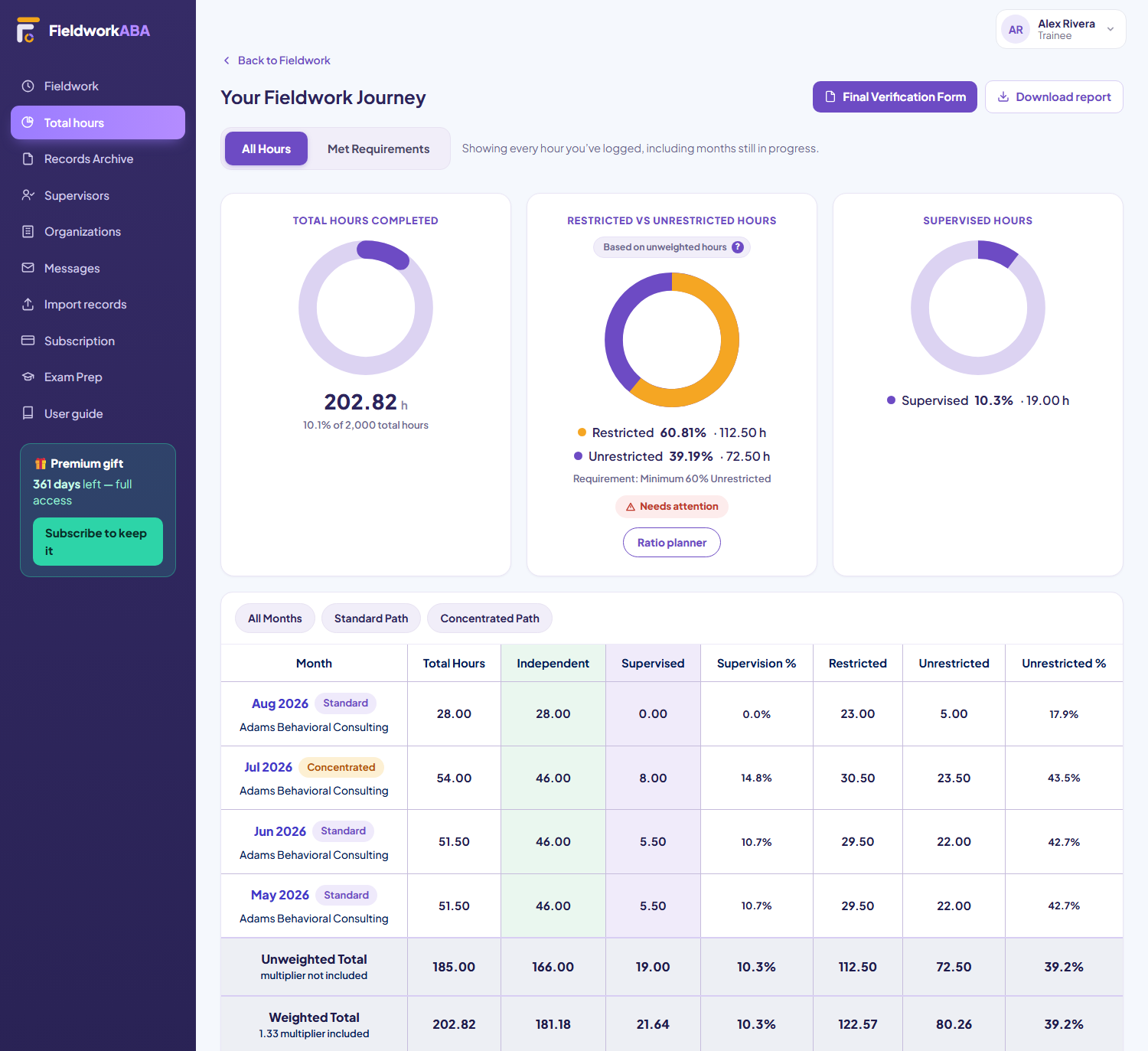
Total hours lists every supervisory period you have logged. The Met Requirements tab hides the months that fall short, so what is left is the set that already satisfies the standard that applies to you. Those are your transfer candidates.
2. See exactly what a month is short of
Opening a month breaks the standard into its separate requirements and shows the gap for each one. In the month below, the total is 6 hours against the 20 hour minimum, and observation time is 0 minutes against the 60 minute requirement, so it fails on two counts. Supervision, at 16.67%, is fine.
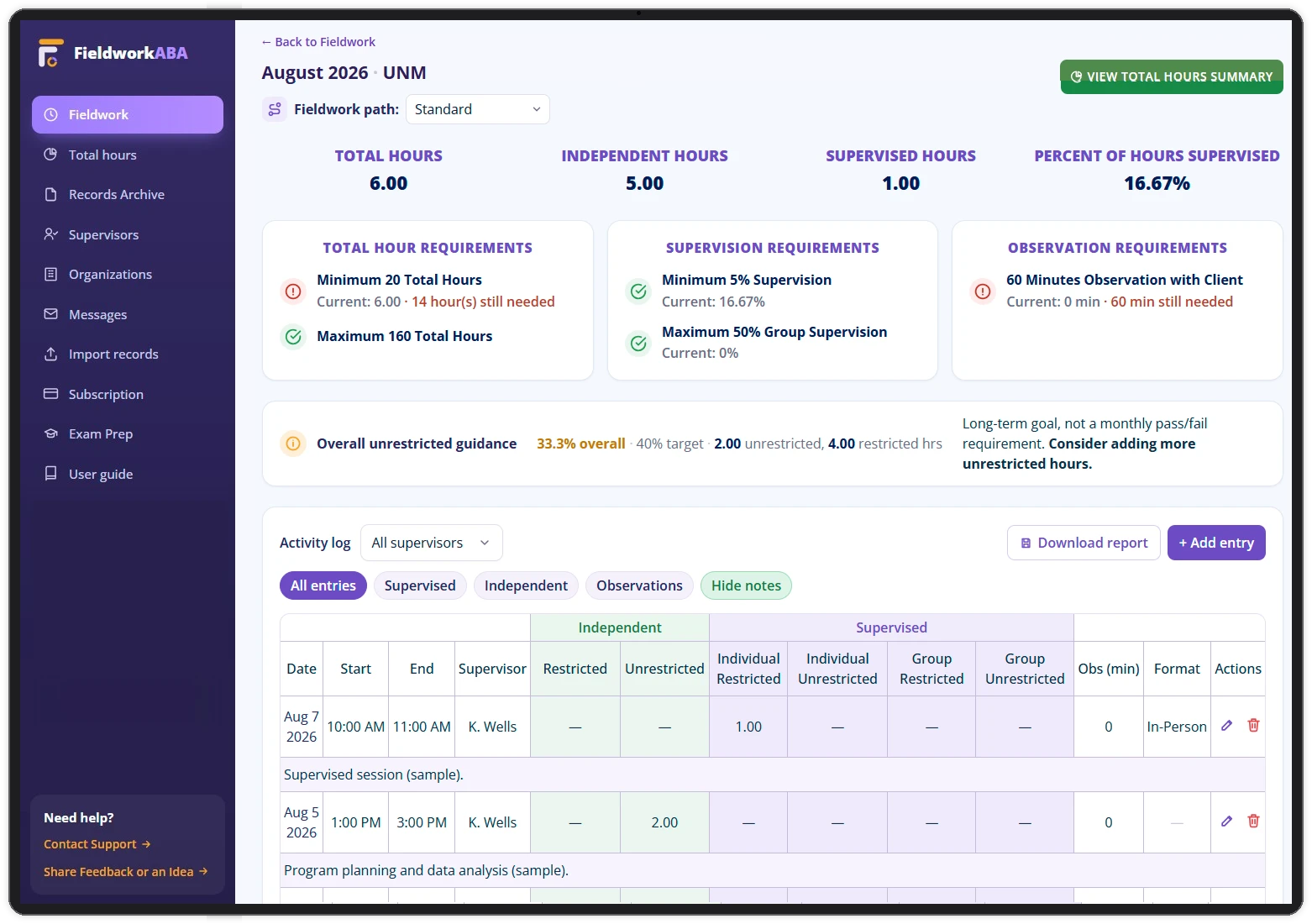
Which thresholds are applied comes from the application date on your profile. Set it to 2027 and each month is measured against 20 to 160 hours, 5% supervision and 60 observation minutes for Supervised Fieldwork, or 7.5% and 90 minutes for Concentrated. Set it before the transition and the older rules apply instead, including the 130 hour cap and the single observation with no duration attached.
The same setting decides which form is generated, so a trainee on the 2027 requirements gets the 2027 M-FVF rather than the one that matches the month being documented. Your supervisor still signs it with the date they actually sign.
Know which months would pass
FieldworkABA checks each supervisory period against the fieldwork requirements that apply to you, so you can see month by month whether your record meets the applicable thresholds. For trainees preparing for the 2027 transition, that makes it easier to identify which older months need attention before application time rather than discovering the issue later.
Start Free What changes in 2027Sources
- BACB, emailed reply to our inquiry, September 2026. Quoted above.
- Guidance for Meeting the BCBA Requirements During the 2027 Transition, BACB, updated 01/2026.
- 2027 BCBA Requirements, BACB.
- 2027 BCBA and BCaBA Requirements: What You Need to Know, BACB.
- BCBA resources and handbook, BACB.
Published September 12, 2026