Table of contents
- What the BACB actually allows
- Three questions, not one
- The same session, counted two ways
- Watching later does not create supervised hours
- What does not count as an observation
- Which month does a recorded observation belong to?
- Under the 2027 requirements, minutes are what count
- What to write down
- How FieldworkABA helps
- Common questions
Getting a supervisor into the room during a session is one of the harder pieces of a fieldwork month to schedule, especially when the supervisor covers several sites or works remotely. A lot of trainees assume that if nobody was physically present, the month has no observation.
The BACB does not require anyone to be in the room. Recorded video and live video both count, and they have counted for years. What changes depending on how the observation happens is not whether it counts, but what else it counts as.
What the BACB actually allows
The requirement itself is short:
“At least one supervisor must observe the trainee working with a client in the natural environment during each supervisory period. In-person, on-site observation is preferred; however, the observation may be conducted using asynchronous (e.g., recorded video) or synchronous (e.g., live video conference) formats.”
BCBA Handbook, BACBTwo details are worth pulling out. The sentence about recorded and live video sits in the current requirements and is repeated word for word in the Handbook’s definition for the 2027 requirements, so this is not a 2027 change. And “preferred” is exactly that: a preference, not a condition. A recorded observation is not a lesser version that needs justifying.
What does not move is “in the natural environment” and “working with a client.” A recording of you running a session in the setting where you normally run it qualifies. A recording of you presenting to colleagues does not.
Three questions, not one
Most of the confusion around observation comes from treating it as a single label. It is really three independent questions about the same block of time, and the BACB’s Fieldwork Checklist and Tip Sheet answers each one separately in its scenario table.
1Did a supervisor watch you working with a client?
If yes, it is an observation. How they watched, in the room, on a live call, or on a recording afterwards, does not change this answer.
2Was there feedback, in real time?
This decides whether the time is supervised or independent. Real-time feedback makes it supervision. Silent watching, live or recorded, leaves it as independent hours.
3What were you actually doing?
This decides restricted or unrestricted, and it has nothing to do with the observation. Direct service is restricted whether or not anyone watched. Parent training or an assessment is unrestricted the same way.
The same session, counted two ways
The Tip Sheet makes the point with a pair of scenarios that describe one situation from two angles: a trainee runs a parent training session, the supervisor watches the recording later, and feedback happens in a 1:1 meeting afterwards.
| What happened | Observation? | Hours |
|---|---|---|
| You and your supervisor watch the recording together in a 1:1, and they give feedback as it plays | Yes | Individual supervision |
| Your supervisor watches the recording later, feedback comes in a separate meeting (counting the session itself) | Yes | Independent |
| That later 1:1 feedback meeting, counted on its own | No | Individual supervision |
From the scenario table in the BACB’s Fieldwork Checklist and Tip Sheet, updated 06/2026. All three of these examples are unrestricted activities, because parent training and assessment are unrestricted. The restricted or unrestricted column follows the activity, never the observation.
Read the middle row again, because it is the one people get wrong. The session where nobody was present is the row that carries the observation.
Watching later does not create supervised hours
The Handbook spells out the trade:
“if your supervisor watches an hour-long video of you delivering services but does not provide immediate, real-time feedback, that hour may count toward the observation-with-a-client requirement, but not the supervisor-trainee contact or total supervised hours requirement. However, if you and your supervisor watch the video together, pausing to discuss feedback and behavior-analytic principles, the hour could count toward all requirements at once.”
BCBA Handbook, BACBLogging an asynchronous observation as supervised time is the most expensive mistake here. It raises your reported supervision percentage without any supervision having happened, and the percentage is checked every month. Watching the recording together is the version that earns all three at once, and it costs the same hour of your supervisor’s time. If they are going to watch it anyway, watching it with you is worth asking for.
The same logic runs through the Tip Sheet wherever a supervisor is present but silent. A supervisor in the same room observing without interacting, a supervisor present for RBT training who gives no in-situ feedback, a supervisor watching a parent training over videoconference without commenting: every one of them is marked as an observation and as independent activity, not as supervision.
What does not count as an observation
Four situations that look close enough to catch people out:
- A phone call with no video. The Tip Sheet scenario where a supervisor is connected by phone and gives feedback while the trainee works with a client is marked as individual supervision, with no observation. Supervision, yes. Observation, no, because nobody saw the session.
- The feedback meeting afterwards. It is individual supervision on its own terms. The observation already belongs to the session.
- Intermittent check-ins. A supervisor who drops in and out while you collect baseline data, and is not present for the whole session, gives you neither observation nor supervision in that scenario.
- Watching somebody else’s video in group supervision. When a group watches a recording of an RBT working with a client and the supervisor comments, that is group supervision. It is not an observation, because the person being observed is not you.
Which month does a recorded observation belong to?
This is the part the BACB has not spelled out. The requirement says the trainee must be observed “during each supervisory period,” and the Tip Sheet says the supervisor watches “at a later time” without putting a limit on how much later.
The reading the Tip Sheet supports is that the observation belongs to the session. In the paired scenarios, the row carrying the observation is the parent training session, not the meeting where feedback was given. On that reading, a September session watched in early October is September’s observation. But the BACB has not said this in so many words, so if a recording will be watched after the month ends, agree with your supervisor which month it is being counted in, and keep the answer consistent across your records and your monthly form.
The safer habit is simply not to let it drift. A recording watched within the same supervisory period raises no question at all.
Under the 2027 requirements, minutes are what count
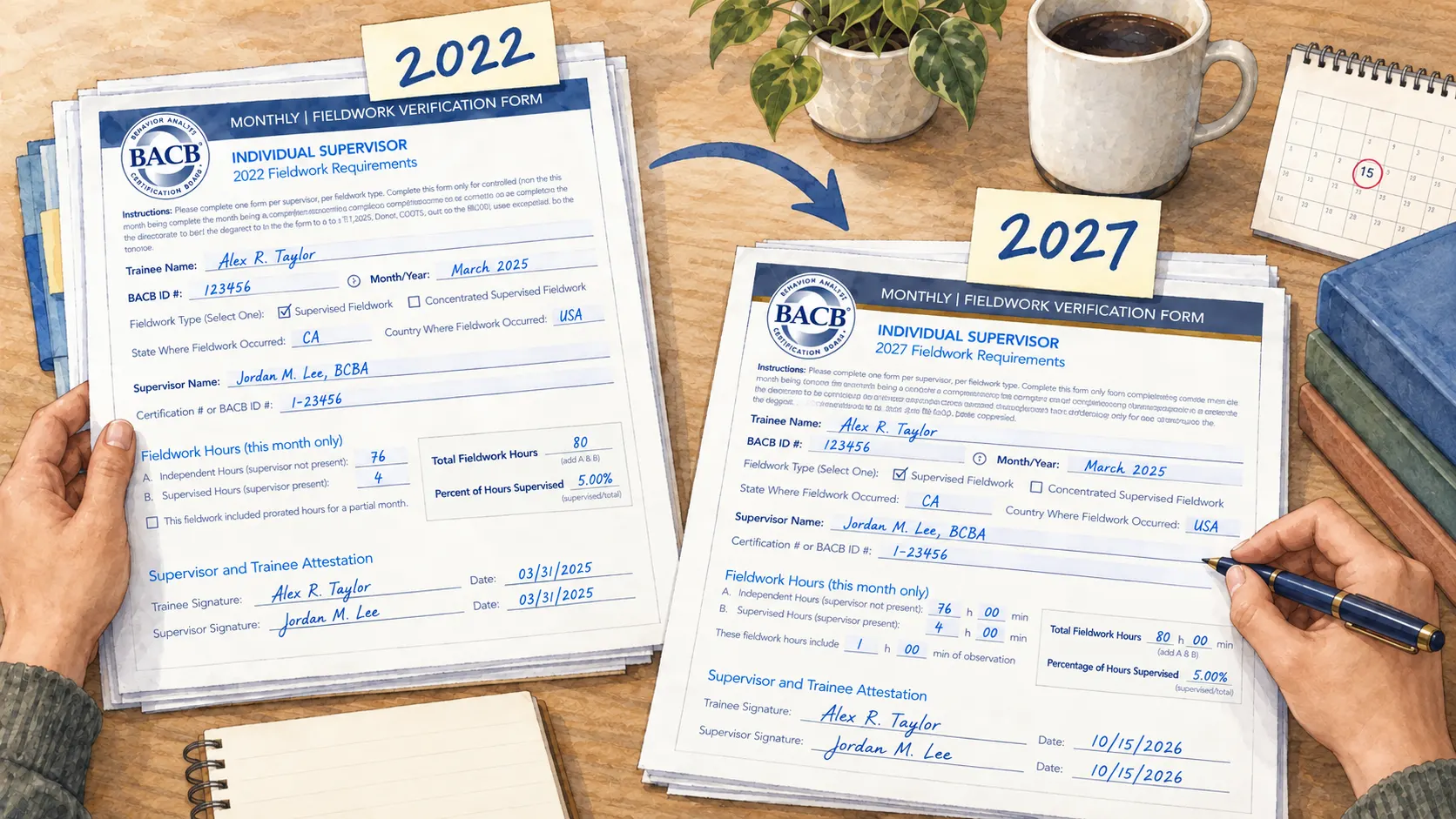
From January 1, 2027, the monthly requirement is no longer one observation. It becomes 60 cumulative minutes of observation with a client for Supervised Fieldwork, and 90 for Concentrated Supervised Fieldwork. Recorded observation still counts, and the format rules do not change.
What does change is that the length matters. In the Handbook’s own example the supervisor watches an hour-long video and an hour counts, because they watched all of it. If your supervisor watches ten minutes of a fifty-minute recording, treat ten minutes as what was observed. Recording a session does not bank fifty minutes of observation on its own.
More on the 2027 side of this in what counts toward your 60 minutes, which works through all fifteen of the BACB’s scenarios.
What to write down
The Handbook asks for the same fields for every observation, whatever the format: date, start time, end time, fieldwork type, setting name, supervisor name, and the activity category. Two more are worth adding for your own protection, because neither is on the monthly form:
- How the observation happened: in person, live video, or recorded and watched afterwards.
- Whether feedback was in real time, since that is the fact deciding whether the same block of time is supervision or independent hours.
If a month is ever audited, those two lines are what explain why an observation sits on a session with no supervised hours attached to it. Keep the answer in your own records, not only in your supervisor’s. More on that in keeping your own copy of your fieldwork records.
How FieldworkABA helps
FieldworkABA is a BCBA fieldwork tracker built around the monthly requirements. When you log hours with your supervisor you enter the observation time in minutes, and the month page checks the running total against the 60 or 90 minutes your fieldwork type needs, so a month that is short shows up while there is still time to fix it. Independent and supervised time stay in separate fields, which is what keeps a silent observation out of your supervision percentage.
The observation goes on the entry for the session it belongs to, which matches the reading above. If the recording gets watched later, the minutes still sit with the session, and the feedback meeting is logged separately as supervision.
Know where the month stands before it ends
Log your hours and FieldworkABA tracks observation minutes, supervision percentage and the monthly hour range against the requirements that apply to you.
Start Free The 2027 observation rulesCommon questions
Can my supervisor observe me from a recording?
Does a recorded observation count as supervised hours?
Can the feedback meeting afterwards count as the observation?
Does a phone call with my supervisor count as an observation?
Sources
- BCBA Handbook, BACB, updated 06/2026. Supervision Requirements, Observation of the Trainee with a Client, and Documentation of Fieldwork.
- Fieldwork Checklist and Tip Sheet, BACB, updated 06/2026. The fieldwork scenario table.